11 November 2026
![My gas strut has no pressure rating, now what?]()
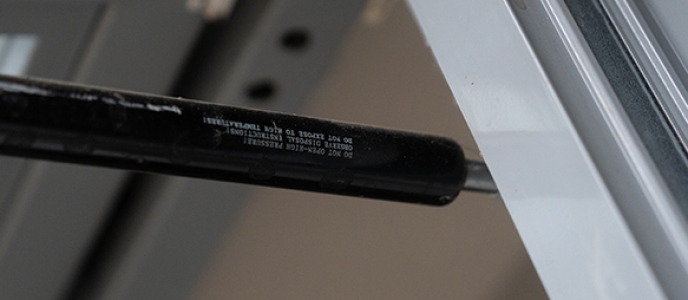
It's a pretty common situation at our Ovesco counter. A customer walks in holding an old gas strut and says, "I need another one of these."
No worries. We can measure the length, check the stroke and identify the end fittings. So far, so good.
Then we get to the force rating.
More often than not, the one part of the printing we actually need is the part that's completely worn off!
So, how do you find the correct replacement when you know everything about your gas strut except how strong it needs to be?
At a Glance
- Matching the length, stroke and end fittings is only part of choosing a replacement gas strut.
- The correct force rating is essential for safe, reliable operation.
- Choosing the strongest available strut can make a door difficult to close and place unnecessary stress on hinges and mounting points.
- The weight, size, mounting position and number of struts all influence the force required.
- Photos, measurements and information about the application can help identify a suitable starting point.
- Local customers can bring their vehicle or equipment to Ovesco for practical assistance.

An all-too-familiar sight at the Ovesco counter. The strut is easy enough to measure, but the force rating has worn away.
Why the force rating matters
Gas struts are rated in Newtons (N), which measure the force they produce.
Two gas struts can have identical dimensions and fittings but completely different force ratings.
Choose one that's too weak and your canopy, toolbox lid or hatch might not stay open. Choose one that's too strong and you could find it difficult to close, or put unnecessary stress on the mounting points and hinges.
Getting the force right is just as important as getting the dimensions right.
"Just give me the strongest ones you've got!"
This is something we hear surprisingly often.
When we can't identify the original force rating, customers will sometimes tell us their door is pretty heavy and ask for the strongest gas struts we have.
The problem is that stronger doesn't necessarily mean better.
Some of our standard-sized gas struts produce around 700N of force, which is roughly equivalent to 70kg-force per strut. However, that does not mean each strut will simply support a 70kg door. The mounting position, operating angle, leverage and number of struts all affect how much force the application requires. That's a significant amount of force, particularly when you're fitting two!
And if your door doesn't need that much assistance, you could end up creating more problems than you solve.
Sometimes that means having a conversation about why we shouldn't simply sell the strongest option available.
It's not always the answer customers want to hear, particularly when they've made the trip into the store hoping to leave with a replacement.
But we'd rather help someone find the correct solution than send them home with something that isn't suitable.
Occasionally, the best advice we can give is to come back with a little more information or bring the equipment in so we can work through it together.
Where do we start when the rating is missing?
At Ovesco, experience is often our starting point.
For example, some lighter canopy applications might use gas struts around 150N. Depending on the weight, size and mounting arrangement, we can use that as an initial reference and work up or down.
Every application is different, though, and there's no single force rating that suits every canopy.
What if you can bring your vehicle in?
If a customer brings their vehicle into our Mayfield West store, we can head out to the car park and help test a suitable gas strut on the application.
We can see how the lid behaves, whether the force is sufficient to support it and how much effort is required to close it.
Sometimes the first option works. Other times, a little adjustment is needed.
It's a practical way of solving the problem together rather than sending someone home with a strut and hoping for the best.
What if you can't visit the store?
We regularly help customers over the phone and via email, so bringing the vehicle in isn't always an option.
In these situations, we might ask customers to measure the load required to support the door at the point where the struts mount.
Before measuring the load or disconnecting an existing gas strut, make sure the door or lid is securely supported. Do not rely on a worn strut to hold it open, and get assistance with heavy or awkward panels where needed.
That information, along with the number of struts, mounting positions and operating angles, helps us estimate a suitable force rating.
It's not a guaranteed measurement, but it can give us a useful starting point.
A little information goes a long way
If you're replacing a gas strut with an unreadable force rating, here's what helps us:
- The original strut's extended length and stroke
- The type of end fittings
- What the strut is fitted to
- Whether the application uses one strut or two
- Photos of the equipment and mounting positions
- Any remaining part numbers or markings
And if you're local, bringing your vehicle or equipment into the store can make the process much easier.
Getting the right result
Replacing a gas strut isn't always as simple as matching its dimensions.
Sometimes it takes a little investigation, some practical testing and a bit of trial and error to get things right.
At Ovesco, we're happy to work through the options with you, whether that means finding a suitable replacement at the counter or helping you gather the information needed to make the right choice. Because getting the right gas strut matters a lot more than simply selling the strongest one on the shelf.
Explore Ovesco’s gas struts or talk to our team for help choosing a gas strut for your vehicle or application.